

Women leading the way: business success despite structural challenges
- The defining factor for women’s success in business has been unmistakable resiliency and adaptability among women worldwide since long before the latest crisis.
- The nature of women’s often smaller businesses allows them to be more versatile and adaptable, due to the requirement for less operating capital.
- Frequently confronted with more sociocultural constraints, female entrepreneurs tend to be more resourceful and more innovative by diversifying their products and services to the new and constantly changing consumer needs, especially during times of crisis.
- Women entrepreneurs are more willing to invest in business development, such as new product development and customer base expansion, and are just as willing to invest in digital tools, services, and training.
“From our own experience working with entrepreneurs, business owners and women in corporate positions over the last 12 years, we can also attest to the fact that many women in business tend to be fuelled by a strong sense of purpose, and often practice an inclusive leadership style that focusses on guiding and encourages collaboration and teamwork,” says Tinyiko Mhlari CA(SA), RA, and director at PSTM Chartered Accountants and Auditors.
“Nevertheless, despite their strong purpose, unique leadership styles, resiliency, adaptability and innovative resourcefulness, women in business – like all business owners – still require targeted support to achieve their full economic potential.”
Women leading the way: targeted support in top ranking economies
- Positive attitudes towards entrepreneurship in general.
- Strong government small business programs.
- Access to financial tools and resources and entrepreneurial funding.
- A high rate of women’s enrolment in tertiary education.
- High representation of women in leadership roles.
Research has identified the above common factors in economies that rank the highest in terms of supporting and driving the number of women business owners.
Of course, these factors and conditions do not exist to an equal extent across countries.
Women-led businesses in South Africa make up only 21% of the formal SME sector.
Ranked by a recent global survey, South Africa occupies the 37th position out of 65 economies in terms of:
* “women’s entrepreneurial activity rate”;
* “women’s business ownership”; and
* “women business leaders”.
The leaders in global rankings are the United States, New Zealand and Canada.
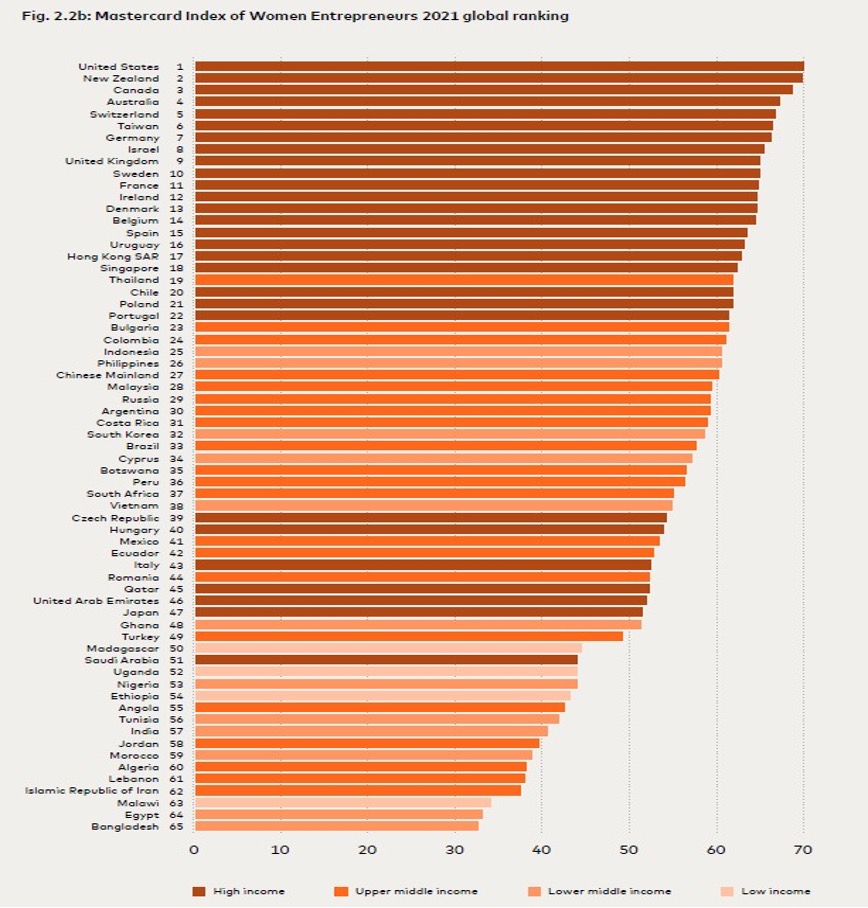
Source: Latest Mastercard Index Women Entrepreneurs (MIWE) which tracks factors and conditions that support and drive the female share of business owners across 65 economies, representing 82.4% of the world’s female labour force.
What the numbers also reveal is that women in business continue to defy the odds despite sociocultural barriers and infrastructural constraints, such as a lack of government SME support, poor access to entrepreneurial finances, severe lack of opportunities for education.
For example, women in low-income countries such as Uganda, Ghana, Malawi and Madagascar are still making their mark as vital economic contributors with a significant 25% “women’s business ownership” of all local businesses.
However, targeted support will enable even more women to participate economically, and to a far greater extent.
[i] https://www.mastercard.com/news/insights/2022/mastercard-index-of-women-entrepreneurs-2021/
[ii] https://www.mastercard.com/news/insights/2022/mastercard-index-of-women-entrepreneurs-2021/
[iii] https://www.mastercard.com/news/insights/2022/mastercard-index-of-women-entrepreneurs-2021/
[iv] Findings from the IFC and Dalberg cited https://www.mastercard.com/news/insights/2022/mastercard-index-of-women-entrepreneurs-2021/
